Finding an influencer used to be fairly simple: search for someone with a large following, check whether they looked relevant to the brand, and start a conversation.
That approach doesn't work quite as well anymore.
A creator with 200,000 followers isn't automatically a better choice than someone with 20,000. The bigger question is whether that creator's audience actually matches the people a brand wants to reach.
That's where AI Influencer Marketing is becoming increasingly interesting.
Artificial intelligence can help marketers process creator information at a scale that's difficult to manage manually. Instead of looking at follower count alone, AI-powered systems can evaluate signals such as content topics, audience characteristics, engagement, brand suitability and campaign requirements to identify potentially stronger matches. Current influencer-marketing platforms are already using AI-assisted discovery and matching in this direction.
For Canadian brands, the opportunity is particularly useful when a campaign needs to reach a specific city, niche, demographic or community.
The goal isn't to let AI choose your influencer for you.
It's to make the search smarter, faster and more informed.
Table of Contents
- What Is AI Influencer Marketing?
- Why Traditional Influencer Discovery Can Be Difficult
- How AI Creator Matching Works
- What Does AI Look At When Finding Creators?
- Why AI Matching Matters for Canadian Brands
- AI vs. Traditional Influencer Discovery
- Where Human Judgment Still Matters
- How Brands Can Use AI More Effectively
- How MicroMatching Fits Into the Modern Creator Workflow
- Frequently Asked Questions
- Final Thoughts
- Ready to Make Creator Campaigns Simpler?
What Is AI Influencer Marketing?
AI Influencer Marketing refers to the use of artificial intelligence and data-driven technology to improve different parts of an influencer campaign.
Creator discovery is one of the most obvious applications.
Instead of manually browsing hundreds of profiles, marketers can use AI-assisted tools to narrow down creators based on a campaign's requirements. Depending on the platform, those requirements might include niche, location, audience characteristics, content style, engagement and previous performance.
The technology can also support campaign management, audience analysis, content evaluation and performance measurement.
Think of it this way: traditional influencer discovery asks, "Who has a large audience?"
AI-assisted discovery can help marketers ask a much better question:
"Which creators are most relevant to this particular campaign?"
That shift from popularity to relevance is important.
Why Traditional Influencer Discovery Can Be Difficult
Finding creators manually sounds straightforward until you actually start doing it.
A marketing manager may begin with Instagram or TikTok and search for creators in a particular niche. After finding a few promising profiles, they still need to check engagement, audience location, content quality, brand fit and whether the creator has worked with similar businesses.
Then comes outreach.
Multiply that process by 50 or 100 creators and it becomes a serious time commitment.
There's another problem: social profiles contain a lot of information, but not all of it is equally useful. A follower count is easy to see. Understanding whether those followers represent the right potential customers takes considerably more work.
That is one reason AI Influencer Discovery is gaining attention. AI can help organize and interpret large amounts of creator data, allowing marketers to spend less time on repetitive research and more time evaluating the strongest candidates.
How AI Creator Matching Works
At its simplest, AI Creator Matching compares what a brand needs with information available about potential creators.
Imagine a Canadian fitness company launching a new product in Toronto and Vancouver.
Its ideal creator might have:
- A fitness or wellness focus
- An audience concentrated in Canada
- Strong engagement
- Content that feels authentic rather than heavily promotional
- Experience creating short-form video
- An audience that overlaps with the brand's target customer
A basic search might return hundreds of fitness creators.
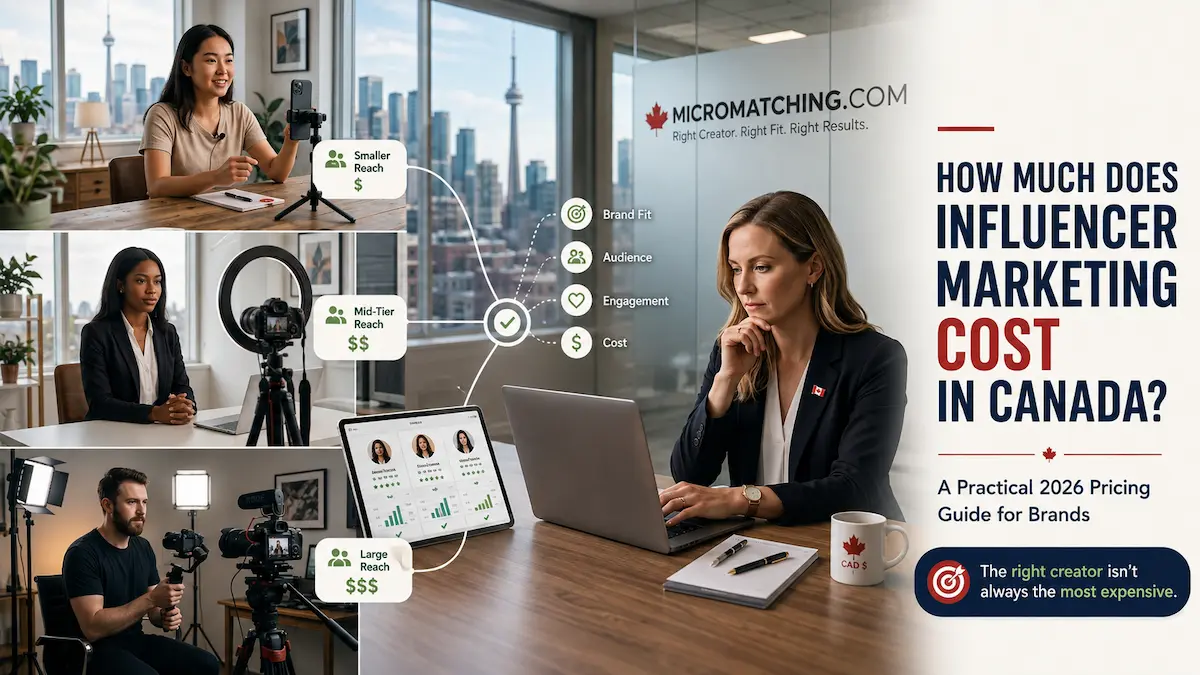
An AI-assisted system can help narrow that pool by comparing multiple signals against the campaign brief.
The result isn't necessarily a single "perfect" influencer. Instead, the technology can produce a more relevant shortlist for the marketing team to review.
That distinction matters. AI is a decision-support tool, not a replacement for marketing judgment.
What Does AI Look At When Finding Creators?
The exact signals vary from one AI Influencer Marketing Platform to another, but several factors are particularly useful.
Audience Fit
A creator's audience should make sense for the campaign.
If a Canadian food brand wants to promote a new restaurant in Calgary, a creator with a highly relevant local audience may be more valuable than a much larger account whose followers are spread across several countries.
Content Relevance
AI can analyze the topics and themes that appear in a creator's content.
That can help brands identify creators who genuinely talk about their category rather than simply matching a keyword in a profile description.
Engagement
Likes and comments aren't everything, but they provide useful context.
A creator's interaction patterns can help marketers understand whether an audience is actively responding to the content.
Location
For local campaigns, geography can make a huge difference.
A Toronto restaurant doesn't necessarily need a creator with a million followers across North America. It may need someone whose audience is actually interested in Toronto dining.
Brand Suitability
The right creator should also be compatible with the brand's values, tone and audience expectations.
AI can help flag potential mismatches, but brands should still review creators themselves before making a final decision.
Modern AI matching systems are increasingly combining these kinds of signals rather than relying on follower count alone.
Why AI Matching Matters for Canadian Brands
Canada presents an interesting challenge for influencer marketers because location can be just as important as reach.
A national campaign might need creators across multiple provinces. A local campaign may need someone whose followers are concentrated within one city.
Consider a Vancouver-based skincare company.
The company could work with a huge international beauty creator, but a smaller Canadian skincare creator may have a much more relevant audience. If that creator's followers are concentrated in British Columbia and regularly engage with beauty content, the partnership could make more sense despite the smaller audience.
This is where Creator-Brand Matching becomes valuable.
AI can help marketers identify patterns that would take considerably longer to uncover through manual research.
It can also make influencer discovery more scalable for smaller marketing teams that don't have the resources of a large agency.
AI vs. Traditional Influencer Discovery
The difference isn't really about replacing one method with another.
It's about improving the process.
| Traditional Discovery | AI-Assisted Discovery |
|---|---|
| Manual profile searching | Data-assisted creator discovery |
| Heavy reliance on follower count | Multiple creator signals |
| Time-consuming shortlisting | Faster candidate identification |
| Spreadsheet-based comparison | Automated analysis |
| Manual research | Pattern recognition across creator data |
| Marketer reviews every profile | AI helps prioritize profiles |
AI can reduce the amount of repetitive work involved in discovery. Human marketers can then spend more time on the things machines are less equipped to judge: brand personality, creative chemistry, communication quality and whether a partnership actually feels authentic.
Where Human Judgment Still Matters
There is a temptation to think that better technology means marketers no longer need to make decisions.
That's not the case.
A creator may look like an excellent match on paper and still be wrong for a particular campaign.
Maybe their communication style doesn't fit the brand. Perhaps their recent content has moved in a different direction. Or their audience technically matches the target demographic but doesn't respond well to sponsored content.
These details require context.
AI can identify patterns and narrow the field. A human should still make the final call.
This human-and-AI combination is likely to be more useful than either approach on its own. It preserves the personal side of creator partnerships while reducing the repetitive work involved in finding potential matches.
How Brands Can Use AI More Effectively
The quality of an AI recommendation depends heavily on the quality of the campaign brief.
Before using an Influencer Discovery Platform, define what you're actually looking for.
Start with your campaign objective. Is the goal awareness, traffic, sales, UGC, app downloads or local visibility?
Then define the audience. Consider location, interests, age range and buying behaviour.
Next, decide what kind of content you need. A product demonstration, testimonial, Reel, TikTok or UGC asset may require very different creator profiles.
Finally, establish your non-negotiables. These might include budget, platform, location, brand-safety requirements or content usage rights.
The clearer the brief, the more useful AI-assisted discovery becomes.
And don't forget to review the recommendations yourself.
The best workflow isn't:
AI chooses → brand accepts.
It's:
Brand defines the goal → AI narrows the options → marketer evaluates → creator partnership begins.
How MicroMatching Fits Into the Modern Creator Workflow
Technology can make creator discovery easier, but brands also need a practical way to manage what happens after they find potential creators.
That's where an Influencer Marketing Platform Canada can become valuable.
MicroMatching is built around helping brands run micro-influencer campaigns through a structured platform rather than relying entirely on DMs, spreadsheets and manual follow-ups. Its current platform supports verified creators, campaign briefs, UGC, post and insight review, campaign management and escrow-based payouts.
The important distinction is that brands don't simply need a list of influencers.
They need a workflow that takes them from campaign idea → creator collaboration → content → performance review.
That broader workflow is where influencer marketing platforms can save time and reduce the operational mess that often comes with running campaigns manually.
For more on creator partnerships, see our guide to influencer collaboration. For a broader look at influencer marketing tools, see our influencer marketing tools guide.
Frequently Asked Questions
What is AI Influencer Marketing?
AI Influencer Marketing uses artificial intelligence and data analysis to support activities such as creator discovery, audience analysis, campaign management and performance evaluation.
How does AI find the right influencer?
AI can compare campaign requirements with creator information such as content relevance, audience characteristics, engagement, location and other available signals. It helps create a more relevant shortlist, while the brand makes the final decision.
Is AI better than manually searching for influencers?
AI can make discovery faster and help marketers evaluate more information. However, it should complement human judgment rather than replace it. Authenticity, communication style and brand fit still require human evaluation.
Can small Canadian businesses use AI influencer marketing?
Yes. AI-assisted discovery can be particularly useful for small teams because it can reduce the time spent researching and comparing potential creators.
Does AI influencer marketing replace creators?
No. The purpose is to improve how brands discover and work with creators. The creative voice, personality and relationship with an audience remain human strengths.
Final Thoughts
Influencer marketing is moving beyond the simple question of who has the most followers.
For brands, the more useful question is becoming: who is the right creator for this particular campaign?
That's where AI can make a real difference.
By analyzing multiple signals and helping marketers narrow down a large creator pool, AI-assisted discovery can reduce manual research and make creator selection more strategic. It can be especially useful for Canadian brands that need to consider location, niche audiences and regional relevance.
But technology shouldn't remove the human side of influencer marketing. The strongest campaigns still depend on trust, authenticity and a genuine connection between creator and audience.
The smartest approach is to let AI handle more of the repetitive research while marketers focus on the decisions that matter most.
Ready to Make Creator Campaigns Simpler?
Finding creators is only one part of influencer marketing. Managing briefs, content, approvals, insights and payments can become just as time-consuming.
MicroMatching gives brands a structured way to run micro-influencer campaigns, connect with verified creators and manage campaign activity from one platform.
Explore MicroMatching and see how a more organized creator workflow can fit into your next campaign.
Also explore the latest influencer marketing trends to see how creator strategies are evolving in 2026.